You may find mei mystifying | The Japan Times
This is a timely Halloween-related article by Mark Schreiber in that it covers the language of some Japanese beliefs, or superstitions. I tend to favor the former term because of a folklore class I took years ago where my instructor taught the word "superstition" is a bit loaded. Or has negative connotations. I can't remember which aspect she stressed the most, but the point she made while discussing nomenclature-- that as a folklorist, your job is not to judge belief but simply to catalog it and research to understand its origins and meanings-- has stuck with me. Schreiber's linguistic explanation of the Japanese word meishin just makes me long for that classroom again. I'd love to discuss some of Schreiber's examples with that professor. She was very cool and open to turning the class into a forum for sharing because she absolutely loved what she was doing.
She made us read some fascinating books, too, all of which I kept after the semester instead of selling them back for beer money the way I did with almost every other required text.
My starting point for studying folklore was my lifelong fascination with "friend of a friend" tales. You know, urban legends. My friends and I grew up absolutely believing in Halloween apples with razor blades in them and hippie babysitters cooking infants in the oven. Sometimes I think I really screwed up my life by not pursuing this interest on a professional level, rather than as just a hobby. I'm not saying I'd have contributed much to the field, but I would have at least satisfied my curiosity and gotten paid to do so.
My favorite Japanese urban legend is Hanako and her haunted toilet, but just about any belief interests me. Number-related ones. Good luck finding an examination room labeled #4 at a Japanese clinic. But other numbers have significance, too, and whenever I meet a new one, I try to find out as much as I can about it.
For example, just yesterday my wife and I were discussing the lousy weather and how it had her down. She's working her butt off at three jobs and she's just plain tired. Some of this she ascribed to this being her unlucky 33rd year. The year you turn 33 is one of those ill-omened years. Why is your 33rd year considered unlucky? Is it any 365-day period before and after the birthday itself, or is it only the year in which you actually turn 33?
I'm disappointed we didn't have a chance to go into all that because we had other, more pressing things to discuss, but this belief is ingrained enough in her family her mom asked her to delay our wedding for one year to avoid the 33rd year misfortune. That was news to me. I knew, though, we chose our anniversary date to avoid inauspicious ones, which you can read about more in Schreiber's article.
In the meantime, make sure you have a full tank of gas if you and your partner park out at Lover's Lane, and if you have a Doberman as your animal companion, check its mouth in case of choking. If you're in Japan, you should probably just stay out of school restrooms altogether.
Showing posts with label folklore. Show all posts
Showing posts with label folklore. Show all posts
Sunday, October 20, 2013


Sunday, October 4, 2009
Spookey Month: Kuchisake-onna, the Slit-Mouthed Woman
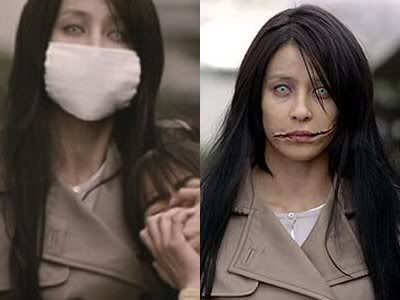 I love urban legends, and I especially love them when they deal with ghosts.
A while back I did an entry about Toire no Hanako-san. You know, the tale of the ghost Hanako, who haunts a particular bathroom stall in a school somewhere here in Japan. With Halloween coming up this month, I want to write a few entries about supernatural Japan and with Hanako-san already out of the way, it's time to turn to Kuchisake-onna, the woman with the big smile.
About a week ago, during a discussion of Halloween and ghost stories, a student laughingly reminded me of Kuchisake-onna. While it's fun to read about Japanese ghost lore, it's even more fun to have someone here actually tell you a story. Somehow that makes it seem more authentic, more real. And, like all good Japanese ghost stories, there's a movie version:
Kuchisake-onna is a strange apparition-- according to lore, on some foggy night she may approach you wearing a surgical mask. That in itself isn't so strange. People wearing surgical masks are a common sight here, especially these days when everyone's talking about the "new influenza."
But you can tell you're dealing with Kuchisake-onna when, instead of merely passing by and going about her business, she stops you and asks you, "Am I beautiful?" The correct answer, of course, is, "Yes!" To make absolutely certain, Kuchisake-onna will then remove her mask...
Revealing a grinning mouth that stretches from ear to ear, full of wickedly sharp teeth.
"Am I beautiful, even like this?" she'll ask. And here's where it gets tricky.
Obviously, you don't want to say, "No." This is Kuchisake-onna and she will rip you to shreds instantly. You might think to answer, "Yes" again. But this only buys you a short reprieve. Because the Japanese word for pretty is kirei, which sounds a bit like kire, meaning "to cut," Kuchisake-onna will follow you home and slice you into little pieces right in front of your own house. You also shouldn't try to run away without answering, because Kuchisake-onna is a sprinter who makes Usain Bolt look he's like running underwater. She can cover 100 meters in 3 seconds!
What you want to do is say, "Ma-ma," which is Japanese for "so-so." Or tell her she's average. This pleases her enough for her to let you go. Another strategy is to ask her if she thinks you're beautiful as well. That really confuses her and gives you time to flee to safety, and perhaps you can exchange keitai information and go shopping together one day and maybe have crepes or om-rice in some cute little restaurant. You might even toss her some fruit. Carry some blueberries or a pineapple whenever you take a walk alone at night as a safety precaution. If you meet her in Shizuoka prefecture, try strawberries-- they're especially popular here.
While this story may date back to the Edo period-- Kuchisake-onna began as an ordinary woman, punished horrifically by her samurai husband for infidelity-- the modern take became popular around 1979, in a version where Kuchisake-onna preyed especially on children. In other versions, an inept plastic surgeon caused her disfigurement, or a motorcycle gang, or an auto accident. She may not kill you, but may instead simply cut you in the same way she is. And she might possibly attack you if you smell of pomade.
Subscribe to:
Posts (Atom)